Going Up: How the American Staircase Became the Room Everyone Wants to Talk About
At some point in the last few years, something happened to the American staircase. It stopped being a way to get from one floor to another and started being the reason someone builds a second floor at all.
Scroll through architectural photography feeds, design awards shortlists, or the portfolios of the most in-demand residential architects in the country, and you'll see it immediately. Stairs that spiral through open volumes like slow-motion ribbons. Cantilevered treads that appear to float in mid-air with nothing beneath them. Monumental stone staircases in private homes that would look at home in a museum. Steel-and-glass configurations that glow from below like something out of a science fiction film.
The staircase has had a renaissance, and it's not a quiet one.
From Utility to Centerpiece
To understand how dramatic this shift is, it helps to remember what stairs used to be.
In the postwar American home — the ranch house, the split-level, the suburban colonial — stairs were almost always an embarrassment. They were narrow, carpeted, tucked against a wall or hidden behind a door. If they showed up at all in architectural photography, it was as background. The goal was to get people between floors efficiently and then get the stairs out of the way.
Even in grander historic American homes, the grand staircase was largely a feature of entryway theater — something to descend dramatically, then forget about. The staircase as a continuous sculptural and spatial experience, woven through the life of a building, was largely a European preoccupation.
What changed? A few things converged at roughly the same time.
Open-plan living, which became the dominant residential design language of the 2000s and 2010s, meant that stairs were suddenly visible from almost everywhere in a home. A staircase you could hide behind a wall became a staircase that floated in the middle of a great room. Suddenly, it had to be interesting.
At the same time, advances in structural engineering and fabrication technology made previously impractical stair designs achievable at reasonable cost. Cantilevered steel stringers that would have required bespoke engineering 30 years ago are now catalog items. Curved concrete staircases that once demanded extraordinary craftsmanship can now be formed with precision using digital fabrication tools.
And then there's the visual economy of social media. A spectacular staircase photographs beautifully. It's vertical, dramatic, and geometric — all things that read well on a screen. Architects and homeowners alike noticed that a stunning staircase could make an entire project go viral. That's not a cynical observation. It's just the reality of how design ideas travel in 2024.
The Architects Making Stairs the Whole Point
In residential architecture, the staircase-as-centerpiece movement has produced some genuinely extraordinary work.
Firms like Olson Kundig in Seattle have long treated vertical circulation as a design opportunity rather than a logistical necessity — their staircases often read as industrial sculpture, combining raw steel with natural wood in configurations that feel both rugged and precise. In the Southeast, firms like Specht Novak Architects have produced residential staircases in poured concrete that are as much wall as they are staircase, defining space as they climb.
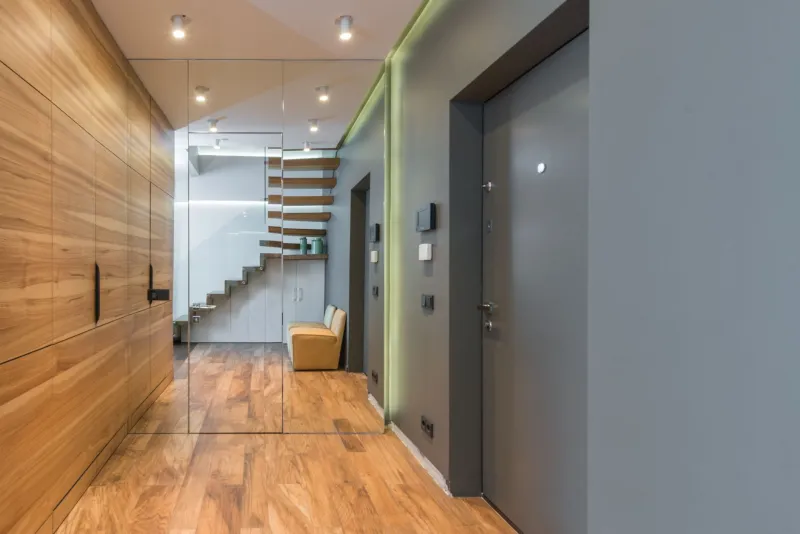
In the New York area, where square footage is at a premium and every design decision has to work hard, architects have been particularly inventive. Staircases that double as bookshelves. Stairs with integrated storage beneath each tread. Floating oak steps with LED strips built into the risers that wash light upward at night, turning the staircase into ambient illumination.
In Los Angeles, where indoor-outdoor living creates different spatial opportunities, some of the most striking staircase work involves exterior stairs — open-air sculptural elements that connect terraced levels of hillside homes while functioning as landscape architecture in their own right.
What ties all of this together isn't a single aesthetic. It's an attitude: the staircase deserves the same design attention as the living room, the kitchen, the facade. It is not an afterthought. It is, in many cases, the spine of the building.
What a Great Staircase Actually Does to a Space
Beyond the visual drama, the best staircase designs do something more interesting: they change how people move through and inhabit a building.
A staircase placed at the center of a home, visible from the entry and the main living areas, creates a kind of vertical social hub. People moving between floors become part of the life of the house rather than disappearing behind a wall. In homes with children, this matters — parents can maintain visual connection to kids moving between levels in a way that a hidden stair corridor doesn't allow.
Curved and spiral staircases slow people down. This is partly physics — you can't take a curved stair at the same pace as a straight run — but it's also psychological. A staircase that requires some attention to navigate creates a moment of transition, a brief pause between the world of one floor and the world of another. Some architects design for this deliberately, using the staircase as a kind of decompression zone between the public spaces of a home's main level and the more private spaces above.
The relationship between a staircase and natural light is another dimension that the best designers think about carefully. A skylight positioned above a central stair can pull daylight deep into a building's interior, using the vertical shaft of the stairwell as a light well. Some of the most celebrated staircase designs in recent American architecture are as much about light as they are about form — the stair is the device that brings the sky into the middle of the house.
Commercial Spaces Are In on It Too
The staircase renaissance isn't confined to residential architecture. In commercial and institutional buildings, stairs have become major design statements in their own right.
The Apple retail stores — with their sweeping, museum-quality glass staircases — did more to mainstream the idea of the spectacular commercial staircase than almost any other single design influence. If Apple was willing to spend what it spent on stairs in a retail environment, the argument went, maybe stairs were worth investing in everywhere.
Since then, corporate offices, boutique hotels, university buildings, and cultural institutions across the country have made their main staircases into signature elements. The Vessel at Hudson Yards in New York City — a publicly accessible sculptural staircase with no other purpose than to be climbed — is the logical endpoint of this trajectory: a staircase so spectacular that it is the building.
The Real Estate Angle
Here's a number that gets the attention of anyone who isn't already sold on staircase design as a serious investment: real estate agents and appraisers in high-end markets are increasingly noting that a spectacular staircase can add meaningful value to a listing.
In markets like Aspen, the Hamptons, Miami Beach, and the wealthier pockets of Los Angeles, a custom-designed staircase is now listed alongside kitchen specifications and primary bath finishes as a selling point. It photographs well for listings. It creates a strong first impression during showings. And it signals something to buyers about the overall quality and intentionality of a home's design.
None of this means that every home needs a floating cantilevered staircase in white oak and blackened steel. But it does mean that the decision of where to put the stairs, how to make them, and what role they play in the spatial experience of a building is one of the most consequential choices an architect or designer makes.
For decades, that decision was made almost automatically. Today, it's where some of the most exciting design thinking in America is happening — one step at a time.