You're Always on Camera: How the Home Office Backdrop Became Your Most Powerful Professional Statement
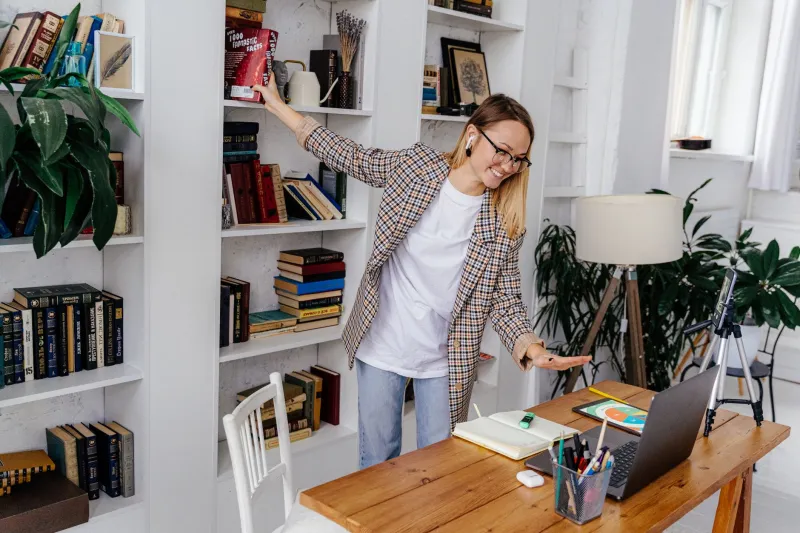
There's a moment most remote workers know well. You hop on a video call, glance at your own thumbnail in the corner of the screen, and suddenly you're not thinking about the agenda — you're thinking about that stack of Amazon boxes behind you, the paint color that reads muddy on camera, or the lamp that's been casting a weird shadow on your face for six months.
Welcome to the Zoom Room effect. It's real, it's reshaping American homes, and designers are paying very close attention.
The Wall Behind You Is Talking
Here's the thing nobody said out loud for the first couple of years of remote work: your backdrop is a design object now. Whether you like it or not, the slice of your home that appears on camera has become a form of nonverbal communication — a curated signal of your taste, your seriousness, and yes, your brand.
"People used to think about their homes in terms of how they lived in them," says interior designer Priya Mehta, who runs a mid-sized residential studio in Austin. "Now they're thinking about how they perform in them. That's a fundamentally different brief."
The shift started around 2020, obviously, but what's interesting is that it hasn't reversed. If anything, it's deepened. Hybrid work schedules have normalized the home office as a semi-permanent professional venue. High-definition webcams and ring lights have made every visual detail more legible. And a culture that's grown fluent in reading spaces — thanks in no small part to years of HGTV, design Instagram, and yes, platforms like this one — means your colleagues and clients are clocking your shelves whether they admit it or not.
Staged Versus Authentic: The Line Designers Are Trying Not to Cross
The tricky part? There's a version of this that goes very wrong. We've all seen it — the suspiciously perfect bookshelf with color-coordinated spines, the single sculptural vase placed just so, the abstract art print that screams "I Googled 'sophisticated backdrop.'" It reads as performance, and it undermines the whole point.
"The goal is never to look like you decorated for the camera," says Marcus Webb, a Brooklyn-based designer who's been fielding a growing number of requests specifically for home office spaces. "The goal is to look like someone with taste happens to work in a great room."
That distinction is doing a lot of work. What Webb and designers like him are actually building are layered spaces — rooms that have genuine personality, functional depth, and a visual coherence that holds up on a 13-inch laptop screen without looking like a set. Books that are actually read. Objects that have actual provenance. Art that means something to the person who hung it.
The authenticity read matters because audiences — even professional ones — are surprisingly good at detecting when a space has been assembled versus lived in. A wall that's been "done" for the camera tends to feel flat. A wall that reflects a real person's accumulation of interests and experiences reads as credible, even compelling.
What's Actually Changing in How Americans Design These Rooms
So what does this mean in practical terms? A few things are shifting pretty noticeably.
Lighting is no longer optional. Natural light has always been a selling point in residential design, but the calculus has changed. Homeowners are now asking specifically about north-facing light for consistent video quality, or building in layered artificial lighting systems that flatter on camera without looking like a studio setup. Window placement relative to the desk — something that used to be an afterthought — is now a genuine design decision.
Color is being chosen for two audiences. The wall color you love in person may not be the wall color that serves you on a call. Certain deep tones that look moody and sophisticated in a room can read as gloomy or washed out on screen. Designers are increasingly consulting on camera-adjusted palettes — not abandoning personality, but stress-testing color choices against how they'll translate through a lens.
The bookshelf has become load-bearing. Not structurally, obviously — but symbolically. The built-in bookcase behind the desk has emerged as probably the single most discussed element in camera-ready home office design. What goes on it, how it's organized, what it says about the person sitting in front of it. Designers report that clients are more deliberate about shelf styling than almost any other element in the house right now.
Scale and proportion matter differently. A piece of art that's perfectly proportioned for a large wall might disappear entirely on a video call, or worse, get cropped in a way that looks odd. Designers are thinking about what reads at distance, what holds up in a small frame, and what creates a sense of depth without visual chaos.
From Instagram to Video Call: A Subtle but Real Pivot
For a while, "will it photograph well" was the design question driving a lot of American residential decision-making. The Instagram-ability of a space became a legitimate factor — sometimes the primary one — in everything from tile selection to furniture placement.
What's interesting about the video call era is that it's a slightly different optimization. Still visual, still image-conscious, but operating on different terms. A great Instagram shot can be carefully staged and lit in a way that a live video call can't. The call happens in real time, in your actual conditions, with whatever light you've got at 2pm on a Tuesday.
That real-time constraint is pushing design choices toward functionality and consistency over spectacle. Less "wow moment," more "this person clearly has their life together." Less drama, more credibility.
"I think it's actually been good for design," says Mehta. "It's moved people away from decorating for a fantasy version of their life and toward designing for how they actually spend their time. That's a healthier relationship with your home."
The Space That Works Hardest
What's emerging from all of this is a new kind of residential priority — the home office as the room that works hardest, not just functionally but representationally. It's the room that shows up in your professional life on a near-daily basis. It's the room that speaks for you when you're not speaking.
For designers, that's a genuinely interesting challenge. For homeowners, it's a reframe that's worth sitting with. The question isn't just "do I like how this room looks?" It's "does this room say what I want it to say about who I am?"
Turn on your camera. Take a look. The answer is already broadcasting.