Touch Wood: Why Designers Are Ditching the Sleek and Falling for the Handmade
Picture the interior that defined the last decade. You know the one. White walls. Flat surfaces. Maybe a single sculptural object on a shelf, positioned with surgical precision. Everything clean, everything considered, everything — if we're being honest — slightly cold. It photographed beautifully. It was easy to maintain. And for a generation of designers and clients who came of age alongside the iPhone, it felt like the future.
Now, a counter-movement is gaining real momentum. And its textures are rough, its edges are uneven, and its whole vibe is emphatically, deliberately not optimized for your screen.
The Backlash Nobody Saw Coming
Call it the tactile rebellion. Across design studios, furniture showrooms, and home interiors from Brooklyn to Portland, there's a growing appetite for materials and objects that communicate something screens fundamentally cannot: the evidence of human hands.
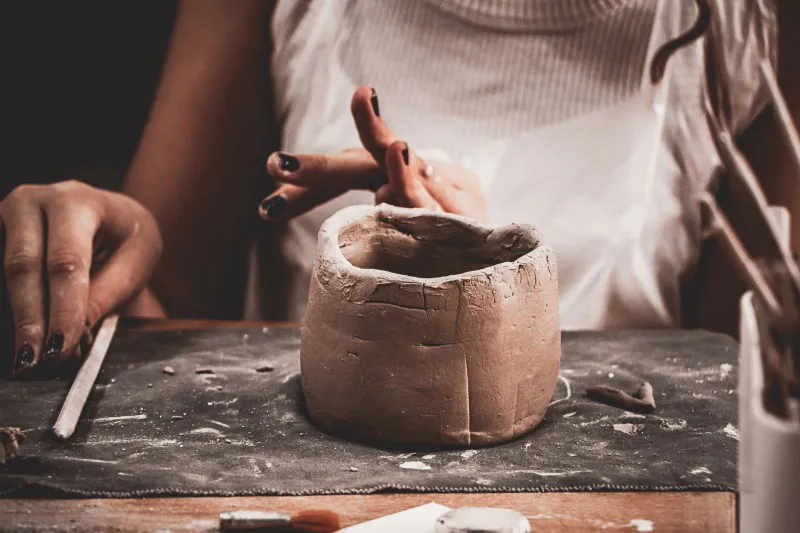
Hand-thrown ceramics with irregular rims. Linen upholstery that wrinkles and softens with use. Reclaimed wood with knots and grain variations that no two pieces share. Plaster walls finished by hand, each section slightly different from the last. These aren't accidents or budget compromises — they're choices. Increasingly, they're the point.
"I had a client last year who specifically asked me not to make anything look too perfect," says Brooklyn-based interior designer Soledad Vance, whose work has been featured in several shelter publications. "She said she was exhausted by perfection. She wanted her home to feel like it had been lived in before she even moved in."
That sentiment — exhaustion with flawlessness — turns out to be pretty widespread.
When Everything Is a Screen, Nothing Feels Real
To understand why tactile design is resonating so strongly right now, it helps to think about what the average American's sensory environment actually looks like in 2024. We wake up and check a phone. We work on a laptop. We watch content on a TV, a tablet, another phone. We order food, manage finances, maintain friendships, and consume entertainment — all through smooth, flat, glass surfaces that give nothing back to the fingertips.
Environmental psychologists have a term for what this does over time: sensory monotony. When our haptic environment — the world we touch — becomes too uniform, the brain starts to register it as a kind of low-grade deprivation. We're tactile creatures by design. We evolved to read texture, temperature, and weight as meaningful information about the world around us.
"There's solid research showing that engaging with varied textures reduces stress markers and increases feelings of groundedness," explains Dr. James Okafor, a behavioral neuroscientist based in Ann Arbor who studies environmental psychology. "When people surround themselves with handmade or natural objects, they're not just making an aesthetic choice. They're feeding a real neurological need."
Designers may not be quoting the research directly, but they're responding to the same signal their clients are sending.
The Craft Revival Gets Serious
What's interesting about this moment is that the tactile design movement isn't just nostalgia. It's not a simple retreat to grandmother's quilt and a rocking chair. It's something more intentional — a deliberate merging of traditional craft techniques with contemporary design thinking.
Studios like Fort Standard in Brooklyn and Grain in Oakland are building furniture that takes cues from traditional joinery while speaking fluently in modern form. Ceramic artists like Adam Silverman, whose work lives somewhere between functional object and sculpture, have moved from gallery-adjacent audiences to mainstream design commissions. Textile designers are reviving natural dyeing and hand-weaving techniques and finding ready markets among clients who want something that couldn't have been produced by a machine.
The sustainability angle matters here too. Handmade objects tend to be built to last. They're often made from natural, biodegradable, or reclaimed materials. And because they're inherently limited in production, they carry a different relationship to consumption — one that runs counter to the churn of fast furniture and disposable décor.
Millennial and Gen Z buyers, in particular, seem to be doing the math on this. A hand-thrown ceramic lamp from a local studio costs more upfront than something shipped overnight from a big-box retailer. But it won't end up in a landfill in three years, it supports an independent maker, and — perhaps most importantly — it means something. It has a story.
Imperfection as Luxury
There's a word that keeps coming up in conversations about this shift: wabi-sabi, the Japanese aesthetic philosophy that finds beauty in impermanence and imperfection. American designers have been borrowing from this framework for years, but something about the current cultural moment has made it land differently.
In a world of infinite digital polish — where photos are filtered, videos are color-graded, and AI can generate a flawless image of anything — imperfection has become genuinely rare. And rare things, as any designer knows, have a way of becoming desirable.
"The crack in the glaze. The slight warp in the wood. The seam you can feel with your thumb," says Vance. "Those things used to be quality control problems. Now clients are pointing at them and saying, 'That's what I want.' It's a complete reversal."
Luxury brands have noticed. Herman Miller's recent collaborations with craft-forward designers, Design Within Reach's expanding curated maker collections, and the explosion of platforms like Chairish and 1stDibs — where handmade and vintage objects trade at serious premiums — all point to a market that's moved well beyond trend territory.
What This Means for Spaces
For the design world at large, the tactile rebellion is starting to reshape how spaces are conceived from the ground up. Architects are specifying hand-applied plaster finishes instead of smooth drywall. Flooring designers are recommending natural stone with visible variation over uniform porcelain tile. Kitchen designers are steering clients toward unlacquered brass hardware that will patina and age — that will, in short, change over time in a way that feels alive.
The goal, increasingly, is to design spaces that reward close attention. Rooms where the more time you spend in them, the more you notice. Where running your hand along a surface tells you something. Where the objects around you have a physical presence that a screen — any screen — simply cannot replicate.
It's a quiet rebellion. But it's one that's leaving its fingerprints everywhere.