Rough, Raw, and Totally Coveted: How Brutalism Became the Aesthetic of the Moment
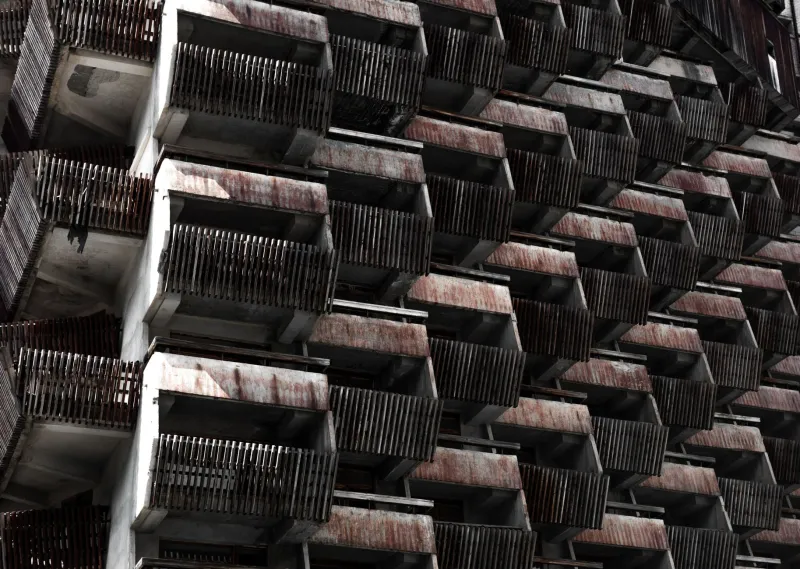
There's a building in downtown Boston that, for decades, commuters actively crossed the street to avoid. City Hall — a hulking, unfinished-looking mass of board-formed concrete — was routinely voted one of the ugliest buildings in America. Then something strange happened. People started lining up to photograph it.
Welcome to the brutalism renaissance.
What was once the architectural equivalent of a bad reputation has become, almost overnight, one of the most sought-after aesthetics in American design. And if you've spent any time scrolling through design-forward Instagram accounts or touring newly opened boutique hotels in Tucson or Marfa, you already know what we're talking about.
From Eyesore to Icon
Brutalism — derived from the French béton brut, meaning raw concrete — flourished in the 1950s through the 1970s. It showed up in university campuses, government buildings, and public housing projects across the US, and it was never exactly beloved. Critics called it dehumanizing. Locals called it ugly. Cities tore it down at every opportunity.
But here's the thing about brutalism: it never actually went anywhere. It just waited.
Architect Mara Castillo, who runs a studio in Brooklyn focused on adaptive reuse, says the shift started quietly about a decade ago. "There was this moment where younger designers stopped apologizing for liking it," she explains. "The honesty of the material — the fact that what you see is literally what holds the building up — started to feel radical compared to all the glass-and-veneer stuff that was everywhere."
That authenticity angle is central to understanding why millennials, in particular, have latched onto brutalism so hard. A generation raised on the promise of transparency and skeptical of polished surfaces — literal and metaphorical — finds something genuinely appealing about a building that doesn't pretend to be anything other than what it is.
The Instagram Effect (It's More Complicated Than You Think)
Let's be honest: social media played a huge role here. Brutalist structures photograph extremely well. The heavy shadows, the monolithic scale, the interplay between rough texture and clean geometry — it's practically made for a high-contrast feed. Accounts dedicated entirely to brutalist photography have racked up hundreds of thousands of followers, turning buildings like the Habitat 67 in Montreal and the Breuer Building in New York into pilgrimage sites for design-obsessed travelers.
But dismissing the trend as purely aesthetic would be too easy. Something deeper is happening.
"Instagram definitely gave brutalism a new audience," says Tyler Okafor, a 31-year-old product designer who recently renovated a prewar industrial loft in Greenpoint with exposed concrete walls and poured concrete floors. "But I didn't fall in love with it because of a photo. I fell in love with it because it felt permanent. Everything else feels so disposable right now."
That search for permanence — for materials and forms that feel like they'll outlast a news cycle — keeps coming up in conversations with young homeowners and renters who are actively seeking out concrete, board-formed walls, and brutalist-adjacent design details.
Developers Are Paying Attention
Where aesthetics go, money follows. Developers across the country have noticed that brutalist-inflected design isn't just tolerated anymore — it's actively marketed as a selling point.
In Phoenix, a boutique hotel that opened last year leaned fully into the style, featuring raw concrete walls, exposed ductwork, and angular outdoor spaces that look like they were carved directly from the desert landscape. Rooms start at $400 a night and book out weeks in advance. In Austin, a residential development in the East Side marketed its poured-concrete facades and heavy brow overhangs as premium features — and priced accordingly.
"We were nervous about it, honestly," admits one developer involved in the Austin project, who asked to remain anonymous. "Concrete finishes used to be the thing you covered up. Now they're the thing you charge extra for."
The shift is showing up in residential interiors too. Concrete countertops, once considered a quirky alternative to granite, are now a staple of high-end kitchen renovations. Polished concrete floors — long the domain of warehouse conversions — are being poured fresh in new construction homes from Nashville to Denver.
The Preservation Angle
Not everyone is celebrating the trend from a purely stylistic standpoint. For preservationists, the brutalism revival couldn't have come at a better time. Hundreds of significant brutalist structures across the US have been threatened with demolition over the past two decades, and shifting public opinion is starting to change the math on saving them.
The recent decision to renovate rather than demolish a major brutalist civic center in New Haven, Connecticut was partly credited to a groundswell of community support — much of it driven by younger residents who organized online campaigns and showed up to city council meetings. It's a pattern playing out in cities from Detroit to Los Angeles.
"We're finally having a real conversation about what we lose when we tear these buildings down," says preservation advocate Dana Whitfield. "They're not comfortable buildings, necessarily. But they're honest ones."
So What Does This Mean for Design?
If you're watching the design landscape — and here at ArchiWorld TV, that's kind of our whole thing — the brutalism moment tells us something important about where American taste is heading. The pendulum is swinging away from the warm, organic, Japandi-inflected minimalism that dominated the last several years and toward something harder, more confrontational, and more willing to make a statement.
That doesn't mean everyone is about to pour concrete floors in their living room. But the broader cultural appetite for materials and forms that feel real — that show their age, their weight, their process — is reshaping everything from residential architecture to hotel design to the furniture showing up at trade fairs.
Brutalism's comeback isn't really about nostalgia. It's about a generation deciding that the things worth having are the things built to last.